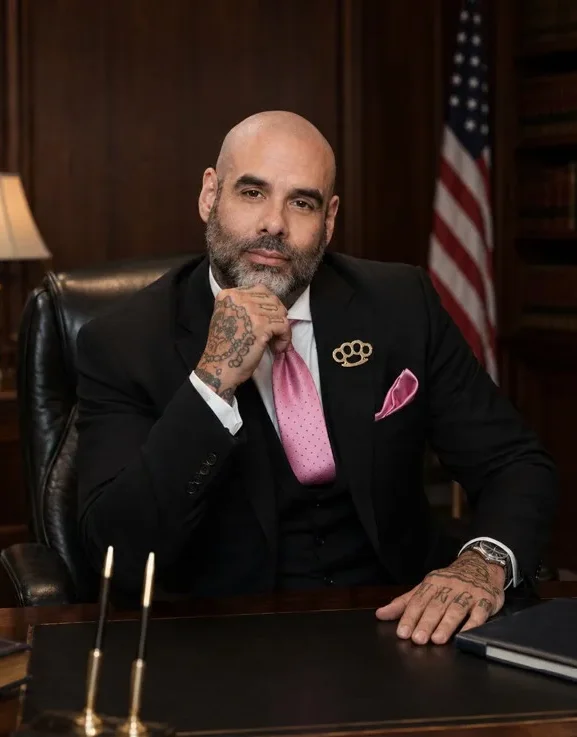
John Leon
Attorney, Law Offices of John Leon
Leading Before the Crisis: How One Attorney Is Redefining Leadership Through the Science of Crisis Management
Every generation produces individuals who do more than excel within their professions—they fundamentally reshape how those professions think.
For attorney, entrepreneur, and crisis management practitioner John Leon, that transformation has centered on one deceptively simple idea:
The best crisis managers are those who begin managing crises long before a crisis ever occurs.
It is this philosophy—and the leadership system that has emerged from it—that has earned Leon recognition among The Influential 100, honoring individuals whose ideas are shaping the future of business, leadership, and organizational excellence.
While Leon’s career began in the practice of law, his influence today extends well beyond the courtroom. During more than two decades of legal practice, he has represented corporations, healthcare organizations, entrepreneurs, executives, professionals, and individuals confronting some of the most consequential legal, operational, financial, and reputational challenges of their careers. Having handled or consulted on thousands of matters and been admitted to nine state and federal courts—including the Supreme Court of the United States—Leon has spent his professional life studying one fundamental question:
Why do some organizations survive crisis while others collapse under the very same pressures?
That question ultimately led him beyond traditional legal practice and toward the broader disciplines of leadership, organizational behavior, decision science, systems thinking, psychology, organizational resilience, and executive decision-making.
Today, Leon is increasingly recognized not simply as an attorney, but as a practitioner seeking to bridge the gap between legal strategy, executive leadership, and crisis management.
Beyond Crisis Management
For decades, crisis management has largely been viewed as a reactive discipline.
A crisis occurs.
Experts are called.
Damage is contained.
Recovery begins.
Leon believes this sequence reflects a fundamental misunderstanding of leadership.
“The most effective crisis managers don’t begin working when the crisis starts. Their work begins months—or sometimes years—before the first headline is ever written.”
That notion became the foundation of the “Leon Crisis Leadership Model” which is largely rooted on Leon’s Pre-Emptive Crisis Management philosophy—a leadership philosophy emphasizing preparation, anticipation, institutional learning, and strategic decision-making before adversity escalates into organizational failure.
Rather than asking how organizations should respond after disaster strikes, Leon encourages leaders to ask an entirely different question:
How do we prevent today’s uncertainty from becoming tomorrow’s crisis?
It is a subtle distinction—but one with profound implications.
The Leon Crisis Leadership Model’s P.R.E.P.A.R.E. Framework
Building upon more than twenty years of practical experience, Leon developed what he calls the P.R.E.P.A.R.E. Framework—a comprehensive leadership system designed to help individuals and organizations think more clearly before, during, and after periods of uncertainty.
Its foundation is built upon a simple philosophy:
We are all crisis managers.
Whether leading a Fortune 500 company, serving in government, practicing medicine, operating a small business, raising a family, or simply making difficult life decisions, every person must regularly make important decisions under conditions of uncertainty.
The framework consists of seven integrated leadership disciplines:
Predict — Anticipate vulnerabilities before they become operational failures.
Recognize — Detect weak signals, emerging threats, and early warning indicators while meaningful intervention remains possible.
Evaluate — Separate evidence from assumptions, emotion from analysis, and urgency from panic in order to make objective decisions.
Plan — Reverse engineer solutions by identifying the worst credible outcome and working backward to prevent it.
Act — Execute decisive leadership through accountability, communication, adaptability, and disciplined action.
Recover — Restore trust, stability, operations, and organizational confidence following disruption.
Evaluate Again — Transform every crisis into future organizational wisdom through structured reflection and continuous learning.
Unlike traditional crisis manuals focused primarily on emergency response, Leon’s model positions crisis management as an ongoing leadership capability embedded within organizational culture.
It is not simply about surviving disruption.
It is about becoming the kind of leader—and building the kind of organization—that thrives because it prepares before uncertainty becomes catastrophe.
Beyond a Framework: A Leadership Operating System
What distinguishes Leon’s work is that P.R.E.P.A.R.E. is supported by a collection of practical leadership models that transform theory into repeatable decision-making tools.
At the center is The Crisis Lens™, teaching leaders to examine every challenge through the perspective of a professional crisis manager by continually asking what assumptions are being made, what vulnerabilities exist, and what risks others may be overlooking.
Supporting that mindset is The Crisis Curve™, which illustrates how seemingly insignificant problems evolve into organizational crises when early warning signs are ignored.
To improve executive judgment, Leon introduces The Decision Window™, emphasizing that every crisis contains a limited period during which thoughtful leadership can still influence the outcome before events begin controlling the organization instead.
Perhaps Leon’s most original contribution is The Reverse Engineering Method™.
Rather than asking, “How do we solve this problem?” Leon teaches leaders to begin by asking, “What is the worst credible outcome?” They then work backward, identifying the sequence of events that would produce that outcome and systematically interrupting those events before they occur.
Recovery extends beyond restoring operations.
Through The Trust Equation™, Leon argues that organizational recovery ultimately depends upon rebuilding competence, integrity, transparency, and accountability—the essential ingredients of institutional trust.
Finally, every crisis concludes with The Crisis Audit™, a structured learning process that examines what was predicted correctly, which warning signs were missed, which assumptions proved false, and what permanent improvements should result from the experience.
Together, these six models transform P.R.E.P.A.R.E. from a simple framework into a practical leadership operating system applicable across business, healthcare, government, military leadership, education, law, and everyday life.
Bridging Practice and Scholarship
One reason Leon’s work has attracted increasing attention is that it connects practical experience with established academic scholarship.
The P.R.E.P.A.R.E. Framework reflects principles explored by leading researchers including Karl Weick’s work on sensemaking, Daniel Kahneman’s research into decision-making under uncertainty, Gary Klein’s studies of naturalistic decision-making, Amy Edmondson’s work on psychological safety, Peter Senge’s systems thinking, James Reason’s organizational error theory, and contemporary scholarship on resilience and organizational learning.
Leon is careful not to position his framework as a replacement for these disciplines.
Instead, it provides an integrative architecture that enables executives, policymakers, healthcare leaders, military professionals, entrepreneurs, educators, and legal practitioners to translate decades of academic research into practical leadership decisions.
A New Vision of Leadership
Perhaps Leon’s most important contribution is philosophical rather than procedural.
He argues that leadership itself should be redefined.
Traditional leadership education emphasizes communication, influence, strategy, organizational culture, and vision.
While essential, Leon believes those qualities are ultimately tested only when certainty disappears.
Leadership, he argues, is demonstrated through judgment.
The ability to remain objective while others become emotional.
The discipline to make difficult decisions with incomplete information.
The willingness to prepare before crises emerge.
The courage to communicate honestly when certainty does not exist.
This perspective has particular relevance as organizations confront artificial intelligence, cyber threats, geopolitical instability, misinformation, regulatory complexity, and rapidly evolving stakeholder expectations.
Tomorrow’s leaders, Leon believes, must first become exceptional decision-makers.
Everything else follows.
From the Courtroom to the Classroom
As his work has evolved, Leon has increasingly turned his attention toward education.
He is developing university lectures and leadership programs introducing applied crisis leadership to students before they assume positions of responsibility.
His objective is not simply to teach crisis management.
It is to cultivate leaders capable of recognizing risk, thinking systematically, communicating transparently, making principled decisions under pressure, and continuously learning from experience.
In Leon’s view, every profession requiring consequential decision-making is, in one form or another, practicing crisis management.
Why Influence Matters
Influence is often measured by revenue, visibility, or professional accolades.
Lasting influence is measured differently.
It changes how people think.
John Leon’s growing influence lies not merely in the legal matters he has handled or the organizations he has advised.
It lies in advancing a broader conversation about leadership itself.
His work challenges organizations to stop viewing crises as isolated emergencies requiring temporary solutions.
Instead, he encourages leaders to build cultures of preparation, resilience, ethical decision-making, institutional trust, and continuous learning.
Whether his ideas ultimately become incorporated into executive education, university curricula, military leadership, healthcare administration, public policy, or corporate governance remains to be seen.
What already appears increasingly evident, however, is that Leon has expanded the conversation beyond crisis response toward something considerably more significant.
He has reframed crisis management as a discipline of leadership.
And in an increasingly uncertain world, that may prove to be one of the most influential leadership ideas of the decade.
For his pioneering contributions to crisis management, leadership education, and the advancement of his philosophy of Pre-Emptive Crisis Management through the Leon Crisis Leadership Model’s P.R.E.P.A.R.E. Framework, The Influential 100 is proud to recognize John Leon among its 2026 honorees.